
Choosing skills for a resume can seem straightforward until you have to decide which claims belong there. Recruiters may judge the section harshly because broad labels are easy to write and hard to verify at a glance; a long list can look like filler if it has no support elsewhere.
This guide settles what the section is for, how to separate different kinds of skills, and a practical way to select them for one specific posting. It also shows how to make relevant terms visible without overstating your experience, whether you are starting out, changing fields, returning after time away, or tailoring an established career.
Key Takeaways
- Use a short, relevant list that points to evidence elsewhere in your resume.
- Separate technical, transferable, and interpersonal skills by what they describe.
- Match posting terms only when they accurately describe your experience.
- Show important skills in work, study, projects, or other relevant experience.
- Expand acronyms when needed and keep credentials distinct from skills.
What a skills section is actually for
A skills section is a navigation aid, not a substitute for the rest of your resume. It gives a reader a quick view of abilities relevant to the role, then points them toward the experience, education, or projects that show how you use them. It is most useful when it is selective and consistent with the rest of the document.
Help a person find relevant evidence
One reader is the person reviewing applications. That reader may spend only a short time locating evidence of a match, so a clear skills section can make relevant strengths easier to find. Use familiar labels and put the most job-related abilities first, rather than asking the reader to interpret a dense block of claims.
That quick scan does not happen in isolation. A hiring manager may check whether the listed skills appear in your job bullets, project descriptions, or qualifications. If you list conflict resolution but give no context for when you used it, the term carries less weight than a concise example of how you handled a difficult customer or scheduling problem.
For a graduate applying to a first analyst role, Excel and data visualization may be credible skills if they appear in coursework or a project. The resume can show the tools in the skills section and describe the analysis, data set, and result in a project bullet. Paid experience is not the only source of evidence, but the source should be clear.
Make relevant terms easy to locate
The second reader may be application software used by an employer to collect, parse, search, or organize resumes. Its functions and settings vary, and not every employer uses the same system or filters. Standard text labels can make relevant terms easier to locate, but no format or keyword guarantees that an application will pass a screen.
Use the posting's language when it truthfully describes your ability. A system may recognize a term as written more readily than an unusual synonym, but software products handle resumes differently. Treat the section as clear text for both people and tools, not a place to repeat every phrase from the advertisement.
Choose evidence over volume
Evidence is why a short list usually works better than a long inventory. Each extra claim creates another question: where did you use it, at what level, and how recently? Choose skills that you can support with a task, output, responsibility, training, or result elsewhere in the resume.
Check each item against three questions:
- Is it relevant to a stated duty or requirement?
- Can you point to a specific example?
- Does the wording describe a real ability, not a trait you hope to have?
Remove items that fail the check. The section should help a reader follow your evidence, not carry the whole case for hiring you.
The three kinds of skill and where each one belongs
A skill can be technical, transferable, or interpersonal, and the categories sometimes overlap. The useful question is what the skill describes and where you can prove it. Use labels that tell a reader what you can do, then put the strongest example in the resume section that shows it.
Technical or hard skills
Technical or hard skills are teachable abilities tied to a task, tool, method, or body of knowledge. They are often easiest to assess because you can name the software, equipment, process, or credential you can use. Examples include spreadsheet analysis, forklift operation, bookkeeping software, laboratory techniques, and a programming language.
Put relevant technical skills in a clearly labeled skills section, using specific names rather than broad claims such as technology. Support important ones in experience, education, or projects. A graduate applying for a first analyst role could list Excel, SQL, and data visualization if they have used them, then describe a class project that cleaned a dataset and presented findings. Do not list a tool merely because it appeared in a course outline.
Transferable skills
Transferable skills are capabilities you can apply in more than one setting. They are not vague strengths; useful examples name an action, such as coordinating schedules, tracking inventory, training colleagues, or resolving service issues.
A warehouse supervisor moving into logistics coordination might highlight inventory control, shift scheduling, dispatch coordination, and delivery problem-solving. Put concise labels in the skills section, then use an experience bullet to show the context: coordinated daily dispatch with warehouse teams and tracked delayed orders through resolution. This connects familiar experience to the new role without pretending the job titles are interchangeable.
Education, volunteering, caring responsibilities, and community projects can also provide evidence when paid work is limited or interrupted. State what you did, rather than asking a reader to infer it.
Interpersonal skills
Interpersonal skills describe how you work with or communicate with other people. Examples include active listening, patient communication, negotiation, clear handovers, and collaboration across teams. They overlap with transferable skills, but interpersonal describes interaction; transferable describes use across contexts.
Use these terms sparingly in a skills section, and demonstrate them in a bullet that names the situation and action. A nurse applying in another country might list patient education or clinical handover if accurate, then explain how they adapted explanations for patients or coordinated handovers across a care team. Keep language proficiency and professional registration separate: a communication skill does not establish a language level or legal authorization to practise.
Place each item where it gets useful proof. A clinical procedure can appear in technical skills and in a clinical experience bullet; a credential belongs in qualifications or education. If paid work does not demonstrate a skill, use a relevant project, course, placement, or volunteer example.
How to choose skills for one job posting
Treat the posting as a guide to priorities, not a script to copy. Work from its duties and requirements, then match each useful term to evidence you actually have.
Read for repeated terms and priorities
Start with the responsibilities and required qualifications. Note words that recur across sections, but do not treat repetition as a scoring formula: a single requirement may still matter, and repeated language may describe the employer's workflow. Separate required qualifications from preferred ones when the posting does so.
Look for nouns naming tools, systems, methods, credentials, and outputs, plus verbs describing actions. For an analyst role, repeated references to data validation, reporting, and SQL are stronger clues than a generic request for motivation. Note the level too, such as preparing reports versus owning a reporting process.
Map each term to real evidence
Before adding a term, write down one example that supports it. Evidence can come from a job, internship, placement, class project, independent work, volunteer role, or recent training. Record what you did and which tool or method you used.
Keep three notes for each term: the wording in the posting, your evidence, and where that evidence appears in the resume. If a posting asks for SQL and your capstone used SQL to join and check tables, list SQL as a skill and explain the capstone in Projects. If your experience was introductory, do not imply advanced or production-level use.
Use the posting's exact wording when it fits
Where accurate, use the posting's wording. If the employer asks for inventory control and you have done inventory control, that phrase is clearer than an unfamiliar synonym. Put it in the skills section or a bullet with context, rather than copying whole sentences or adding unsupported keywords.
Do not inflate a near-match. Coordinating a weekly spreadsheet is not automatically advanced data analysis, and attending a workshop does not establish professional proficiency. Describe the task and your level honestly; relevant adjacent experience can still help a reader understand your fit.
Handle acronyms and local terminology
Expand an acronym on first use if readers may not know it, then include the abbreviation in parentheses when it appears in the posting. For example, write customer relationship management (CRM) if both forms matter. Do not repeat both forms throughout the resume.
Check local terminology for regulated roles. A nurse applying in another country should use clinical skill terms only when they match their experience, and list registration, language ability, and required training separately. Titles and credentials may not transfer directly, so verify requirements rather than implying equivalence.
How many skills, and how to write them
Your skills section should let a reader spot relevant capabilities without searching through every role. For many resumes, roughly eight to twelve skills is a useful starting point, not a fixed quota. The right count depends on the role and your experience.
Choose a useful number and group related skills
A focused role may need fewer, precise skills. A specialist position may call for a wider set of tools, methods, or technical capabilities. If you are adding weak or repetitive items just to reach a number, stop sooner.
Group related entries under simple labels when that makes the section easier to scan. You can use categories such as:
- Technical skills: data analysis, laboratory testing, or bookkeeping.
- Tools: Excel, Salesforce, or a programming language you use.
- Methods: budget forecasting, user research, or quality control.
- Languages: name each language and, if useful, your level.
Keep the grouping relevant to the vacancy. A short, tailored list is usually easier to read than a long inventory that mixes unrelated abilities.
Use clear, scannable terms
Write skills as concise terms or phrases, rather than full sentences. Use the wording from the job posting when it accurately describes your experience. For example, if the posting asks for inventory management, use that term if you have managed stock, rather than a broad phrase such as operations knowledge.
Be specific enough to distinguish one capability from another. Project coordination is clearer than organized, and SQL is clearer than computer skills. Avoid unexplained abbreviations unless they are common in your field or appear in the posting.
Skip rating bars and dot scales
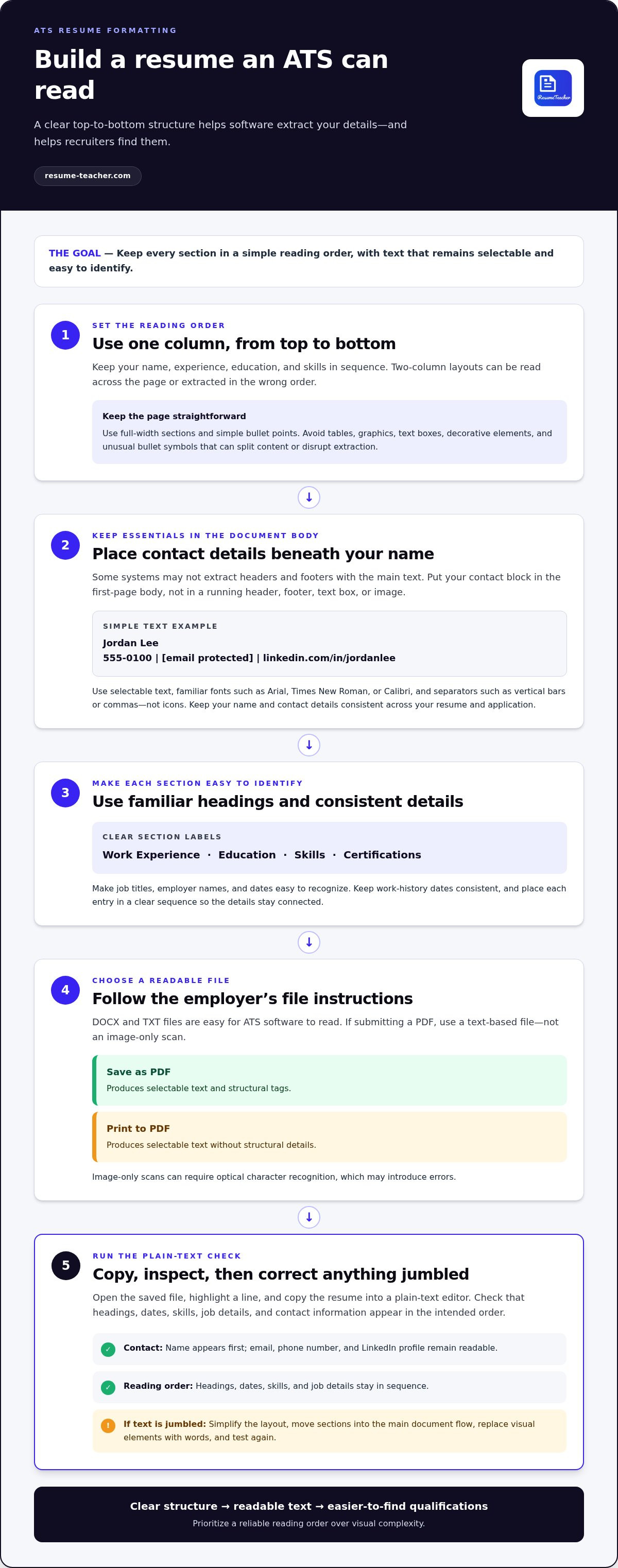
Bars, stars, and dots do not explain what a rating means. A reader cannot tell whether four dots out of five represent tested ability, years of use, or your own estimate. These graphics can also be difficult to interpret consistently when a resume is read on a small screen or printed.
Screening systems vary, and a visual scale may be treated as a graphic or lose its intended meaning when the document is parsed. Use plain text instead. If a level matters, state it clearly, such as conversational Spanish or advanced Excel, and be prepared to explain what that level means in practice.
Skills for graduates, career changers and people returning to work
You do not need to have been paid for a skill to include it on a resume. What matters is whether you have used it, whether it fits the role, and whether you can give a truthful example of how you applied it.
Use evidence from different settings
Coursework can show practical ability when you describe what you did, not just the subject you studied. A graduate might list data analysis after cleaning a survey dataset for a research project, or presentation design after preparing and delivering a project briefing.
Volunteering and freelance work can also provide concrete evidence. Include the skill and the context, such as scheduling volunteer shifts for a community event or editing website copy for a small client. If the work was unpaid, say so when that context helps the reader understand the experience.
- Course project: created a cash-flow forecast using spreadsheet formulas.
- Volunteering: coordinated event registrations and volunteer schedules.
- Freelance work: edited articles to a client brief and deadline.
Describe skills developed outside formal work
People returning to work may have relevant skills from a previous job, personal projects, community activities, or caring responsibilities. For example, you might have planned schedules, managed records, or coordinated appointments. Describe the capability without sharing private details about the person you cared for.
Use wording that names an action and its context. A resume entry such as scheduling and logistics, coordinated appointments and transport across changing weekly commitments is more informative than simply listing multitasking. Do not imply that personal responsibilities were a paid job or a formal professional role.
List training and credentials accurately
Relevant certifications can support a skills section, especially when a role asks for a particular qualification or method. Use the credential's correct name and identify the issuing organization if that helps clarify it. If you are still studying, label it as in progress and include an expected completion date only if you know it.
For skills gained through any setting, keep the description proportional to your experience. You can show a skill without overstating your level, and you can give fuller evidence in a project, volunteer, or employment entry elsewhere on the resume.
What to leave off a skills section
A skills section is more useful when each item helps a reader assess your fit. Leaving out vague, irrelevant, or unsupported claims makes room for the capabilities that matter to the role.
Remove basics that add no useful information
Do not automatically list basic computer use, email, internet browsing, or word processing when these are expected for the roles you want. They may be worth mentioning if the job posting specifically asks for them or if the skill is not commonly assumed in your target field. Consider what the reader will learn from the entry, rather than treating every task you can do as a resume skill.
The same applies to general statements such as able to work independently. If a basic capability is important, show how you use it in a relevant role or project instead of giving it a place in a crowded list.
Leave out claims without evidence
Do not list a skill simply because it appears in the job posting. If you have not used it, studied it, or practised it enough to explain your experience, it is not a reliable claim. An interview may include questions about your methods, tools, or results, so a skill you cannot discuss can weaken the rest of your application.
Keep broad claims proportionate. If you have used a tool once in a class, describe that context rather than presenting yourself as an expert. If you are still learning a skill, include it only when it is relevant and label your level honestly.
Check tools and methods for relevance
Technology changes, and a tool you used in a previous role may no longer matter to the positions you want. Remove outdated tools when they take space from current, relevant skills. Keep an older tool if the vacancy asks for it or your experience with it is still useful in that field, and make sure your description reflects what you can do now.
Replace soft-skill clichés with evidence
Words such as hardworking, motivated, team player, and detail-oriented are common, but they do not show what you can do. A reader gets more information from a specific capability, such as checking invoices against purchase orders, or from a work example that demonstrates collaboration.
If a personal quality is important to the role, support it with evidence elsewhere on your resume. For example, describe how you coordinated a handover across teams rather than relying on the phrase excellent communicator. This keeps the skills section focused on clear, assessable capabilities.
Where Resume Teacher Fits
Resume Teacher offers guided writing section by section and 50+ ATS-ready templates. You can use Resume Teacher's resume builder to organize your information and review your skills against the role you want.
You can start your first resume for free without a card, import an existing resume from PDF or DOCX, and download PDFs without a limit. The service is GDPR compliant.
Frequently Asked Questions
How many skills should I put on a resume?
For many applicants, roughly eight to twelve relevant skills is a useful starting point. It is not a fixed rule: a focused role may call for fewer, while a specialist position may require a wider set of tools or methods. Choose entries that match the vacancy and that you can support with examples. Remove repeats instead of filling space to meet a number.
What are the best skills to put on a resume?
The best skills are the ones the role needs and you can demonstrate. Review the job posting for required tools, methods, and capabilities, then include the ones you have genuinely used or learned. A list that fits one vacancy may not suit another. Give more space to specific, relevant skills than to broad claims that could describe almost any applicant.
Should I include soft skills on a resume?
Include a soft skill when it is relevant, but avoid presenting a string of labels such as hardworking or good communicator. Show what the skill looks like in practice through a concise example, such as coordinating work across teams or resolving a customer issue. If space is limited, use the skills section for concrete capabilities and demonstrate personal qualities in your experience descriptions.
How do I list skills on a resume with no work experience?
Use relevant evidence from coursework, personal projects, volunteering, freelance work, or other responsibilities. Name the skill and give enough context to show how you applied it, such as using spreadsheet formulas to analyse a class project. Do not imply that unpaid experience was paid employment. Keep your claims accurate, and be ready to explain what you did and what you learned.
Should I rate my skills on a resume?
Usually, avoid rating skills with bars, stars, or dots. The scale is subjective, so readers may not know what a rating means, and screening software may not preserve the visual information as intended. If proficiency is important, use a plain-text description such as beginner, advanced, or conversational, and only when you can explain the level. Otherwise, show ability through a relevant example.
How do I tailor my skills section to a job?
Compare your skills with the requirements in the job posting. Include relevant terms from the posting when they accurately describe your experience, and remove items that do not help show your fit for that role. Keep the list easy to scan and make sure important skills are supported elsewhere on your resume with examples from work, study, projects, or volunteering.

Article by
Dr Mutyaba Ashraf Semakula
Hi, I’m Ashraf, the founder of ResumeTeacher, a platform dedicated to helping people present their skills, experience, and achievements with confidence.
I created ResumeTeacher because I believe everyone deserves the opportunity to pursue their career goals. However, writing a professional resume or cover letter can be challenging, especially when you have valuable experience but struggle to communicate it effectively. My goal is to make that process simpler, more accessible, and less stressful.
I’m passionate about technology, career development, and creating practical solutions to everyday challenges. Through ResumeTeacher, I help job seekers build professional resumes, create compelling cover letters, and organize their job applications more effectively.
I also enjoy sharing practical advice through articles on resume writing, job search strategies, interview preparation, and career growth. I want my content to be useful, easy to understand, and relevant to people at different stages of their careers, from first-time job seekers to experienced professionals looking for new opportunities.
Building ResumeTeacher is my way of combining technology with a purpose that matters to me: helping people communicate their value and approach their careers with greater confidence. I believe that while no tool can guarantee a job, having the right resources and presenting yourself professionally can make the journey easier.
Through my work and writing, I hope to help people recognize their strengths, improve their applications, and take meaningful steps toward their professional goals.

